June 15, 2026
There’s a version of leadership we are often shown.
Confident. Certain. Decisive. Always composed. Always clear.
But if you’ve worked in public health and social care or complex systems long enough, you know that’s not the full picture. Real leadership is often uncomfortable. It’s rarely neat.
And most of the time, it goes against the grain.
This month, I’ve been reflecting on what that actually looks like in my practice. Not the theory, not the frameworks, but the day-to-day choices that shape how I lead. These reflections did not come from a leadership programme or a textbook.
They emerged from years of working across public health and social care, higher education, research, and community based settings.
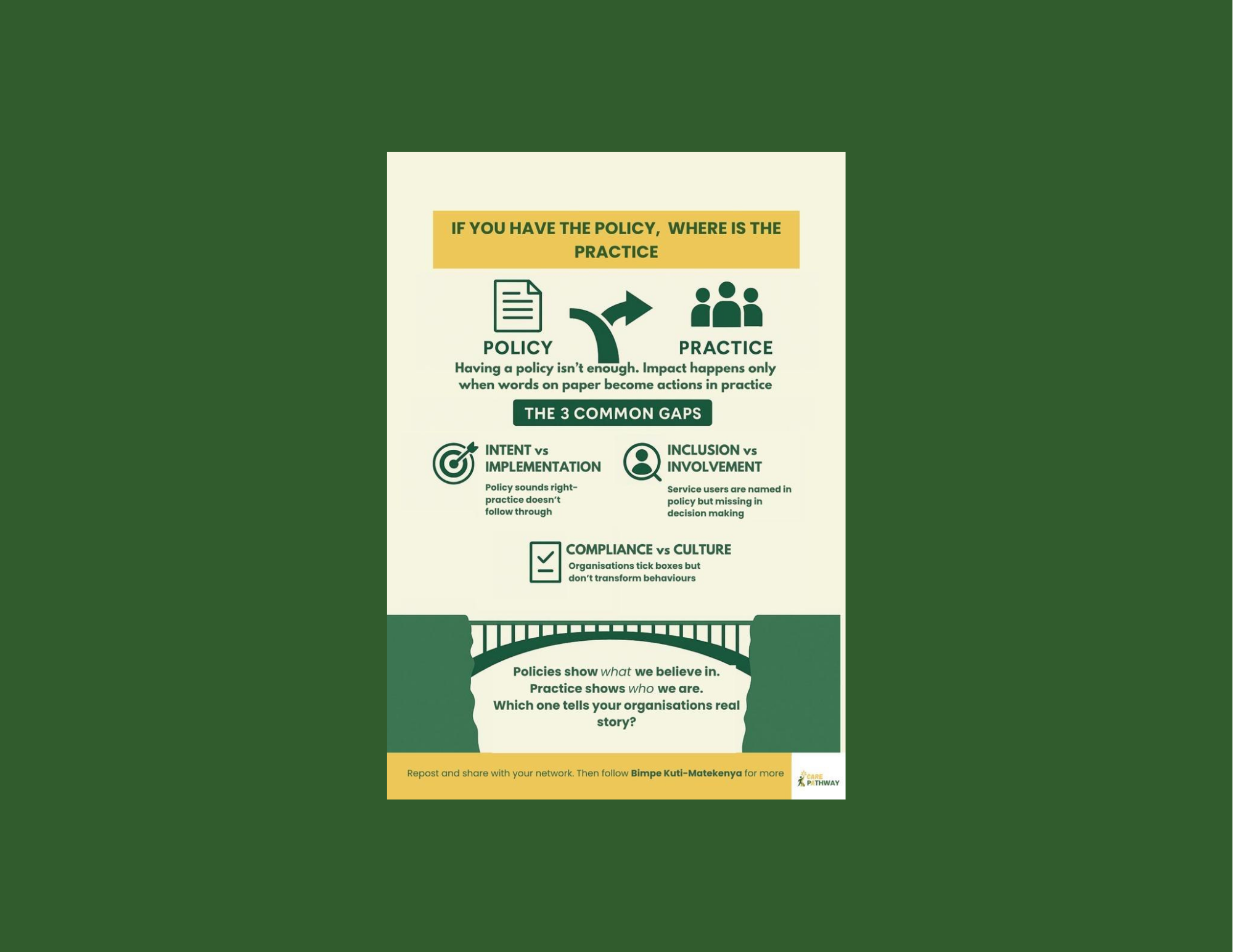
Throughout my career, I have sat in countless meetings from top of strategic commissioning meetings to staff team meetings where organisations spoke passionately about person-centred care, co-production, engagement, inclusion, and reducing inequalities.
Yet some of the most important conversations I have had have happened outside those meetings. They have happened with patients who felt unheard despite being consulted. Carers who felt invisible despite carrying significant responsibilities. Communities who had been invited to participate in discussions but had little influence over the decisions that followed.
The challenge was rarely a lack of good people or good intentions. More often, it was the way systems operated - prioritising process over people, representation over participation, and activity over impact.
These experiences fundamentally, now shape how I lead.
My leadership journey in Public Health and Social Care has taught me that meaningful change requires more than good policies, well-written strategies, or the right language. It requires the courage to challenge assumptions, share power, embrace complexity, and remain focused on the people our decisions ultimately affect.
What follows is not a formula for leadership. It is a reflection on the principles that have consistently guided me through complex decisions, difficult conversations, and uncertain situations. They have been shaped by practice rather than position, strengthened by learning, and continually refined through reflection. They are the foundations I rely on when navigating the realities of leading within complex systems.
It’s easy to say “person-centred.” It’s harder to design systems that genuinely share power. I don’t involve people as a checkbox. I involve them as decision-makers. If their voice doesn’t shape the outcome, it isn’t involvement.
Inviting one service user into a room doesn’t equal inclusion. I ask: Who is missing? Who holds power? Who benefits? That discomfort is necessary. Without it, we reproduce the same inequalities we claim to address.
In academia and practice, there’s a tendency to wait - for funding, for approval, for the “right time.” I don’t. test ideas, pilot quickly, learn in real time, and refine. Progress comes from movement, not perfection.
A good session, a powerful workshop, a successful project, that’s not enough. I ask: What changes after this? If it doesn’t influence policy, practice, or people long-term, then it hasn’t gone far enough.
Not every opportunity aligns. Not every partnership is right. I choose work that reflects equity, integrity, and impact—even if that means walking away from easier wins.
Academia. Practice. Communities. Policy. Each speaks a different language. My role is to connect them, so evidence is understood, lived experience is respected, and decisions are actually usable in the real world.
Curricula matter. Strategies matter. But people carry the work forward. I invest in building confidence, critical thinking, and leadership in others, because sustainable change is collective.
Health and social care challenges are messy. I resist the pressure to reduce them into neat soundbites. Honest leadership means holding nuance, uncertainty, and contradiction, without losing direction.
Whether with students, staff, service users, carers, or communities, people need psychological safety to speak honestly. The most powerful insights often come from what is usually left unsaid.
Numbers matter, but they don’t tell the full story. I look for shifts in voice, confidence, access, and power. If people feel more heard and systems respond differently, that’s impact.
None of this is particularly easy. None of this is fixed either. Working across public health, social care, education, and communities has taught me that leadership rarely offers neat answers.
Context matters. People matter. Relationships matter. Rather than relying on a fixed playbook, I try to remain anchored in my values while adapting my approach to the complexities, opportunities, and challenges that each situation presents.
For me, leadership is not defined by certainty but by responsiveness. It requires listening deeply, weighing evidence alongside lived experience, and making thoughtful decisions in situations that are often complex and evolving.
Values provide the foundation, but it is reflection, adaptability, and the ability to work with people that turn those values into meaningful impact.
So, if we are serious about improving population health; If we are serious about reducing inequalities; If we are serious about building systems that genuinely work for people;
Then leadership has to look different.
But courage, humility, curiosity, and the ability to hold complexity without looking away.
The leadership lessons that have shaped me rarely came from moments of certainty. Most came from listening to people whose experiences challenged my assumptions and forced me to see systems differently.
Perhaps that is why the leadership that matters most often goes against the grain.
BUT these 10 principles above work.
So here's the question I'll leave with you:
What do you do that goes against the grain?
The uncomfortable choices are often the most important ones. More importantly, they are often the choices others need to hear.
If this resonated, share one of yours.
What experience has most influenced the way you lead today?
Let's make space for the kind of leadership we don't talk about enough
.png)