January 19, 2026
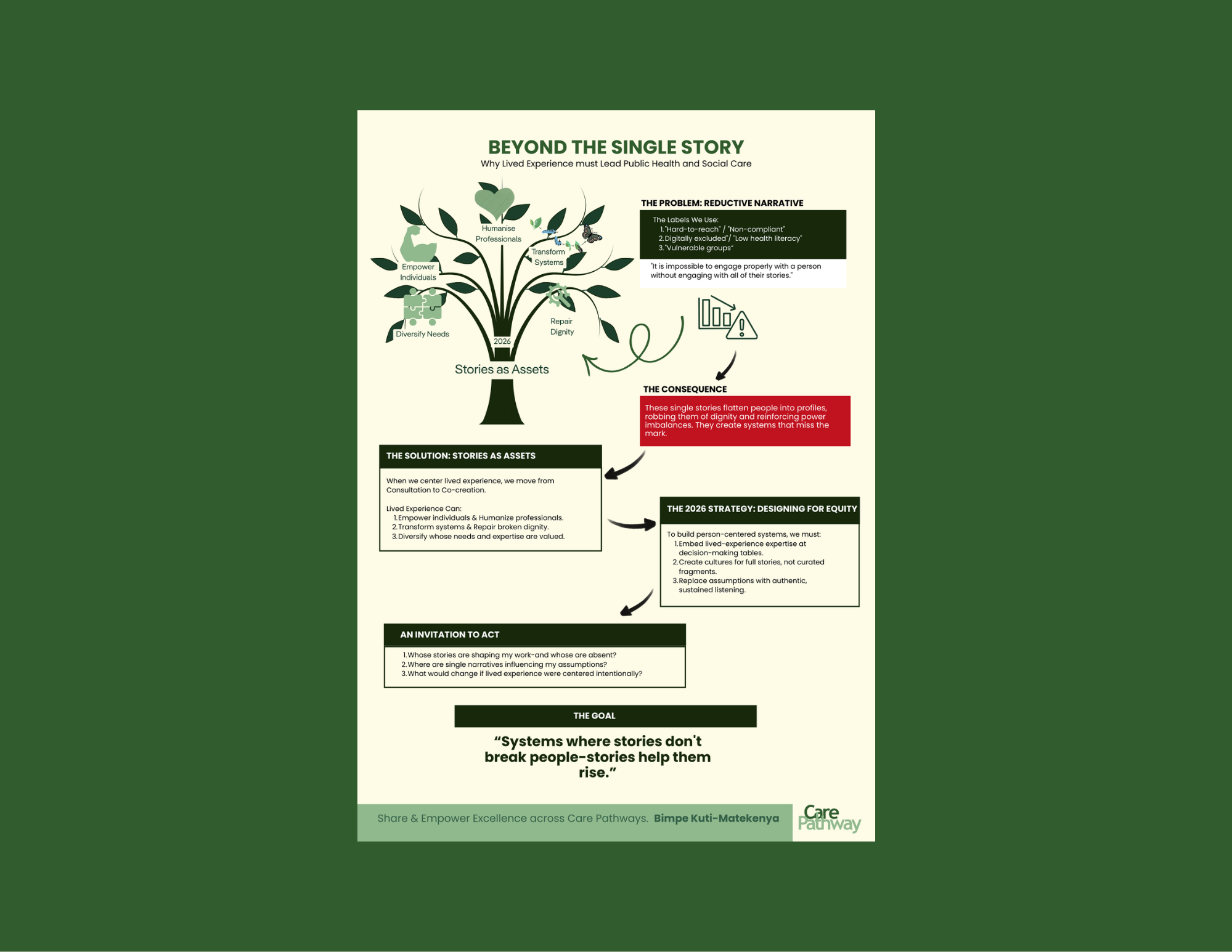
Download Infographic Here
Every January offers a moment to reset, re-centre, and re-examine the stories we hold about ourselves, our work, and the people we serve. As we step into 2026, I am drawn to reflect on a powerful truth:
“It is impossible to engage properly with a place or a person without engaging with all of the stories of that place or that person.”
This insight, taken from the well-cited concept of “The Danger of a Single Story”, is not simply a literary idea, it is a public health imperative, a social care responsibility, and an educational requirement.
The Single Story in Public Health and Social Care
Care systems often operate on single narratives:
These descriptions could easily become reductive labels that flatten people into one-dimensional profiles. The consequence of these single stories is profound:
In public health, where context, history, identity, culture, and lived realities matter, single stories can shape policies, interventions, and service models that miss the mark entirely.
Stories as Assets
Stories of lived experience when held, heard, honoured, and embedded meaningfully can:
In every corner of the health and social care ecosystem: from clinical practice to policy development, from teaching to research, stories shape understanding and action. When we diversify whose stories are centred, we diversify whose needs are recognised, whose realities are prioritised, and whose expertise is valued.
Why Lived Experience Must Sit at the Centre of 2026
Across my professional practice, in public health and social care leadership, curriculum design, practice based collaboration, teaching and research, I see the same truth:
Equitable, person-centred systems cannot be achieved without embedding lived experience meaningfully and structurally.
Not as a single narrative. But as a constellation of voices: complex, contradictory, diverse, dynamic and always human.
The opportunity before us in 2026 is not simply to include lived experience, but to design for it:
An Invitation to Reflect and Act
As you step into the year ahead, I invite you to reflect on three questions:
Our shared ambition must be to build public health and social care systems where stories do not break people stories help them rise.
This is the essence of my professional reflections, with Care Pathway: Empowering Excellence through the dignity of shared stories, lived realities, and co-created solutions.
Here’s to a year of many stories, deeper understanding, and more human-centred practice across the sector.
PS – The People’s Healthcast – Coming Soon!
.png)